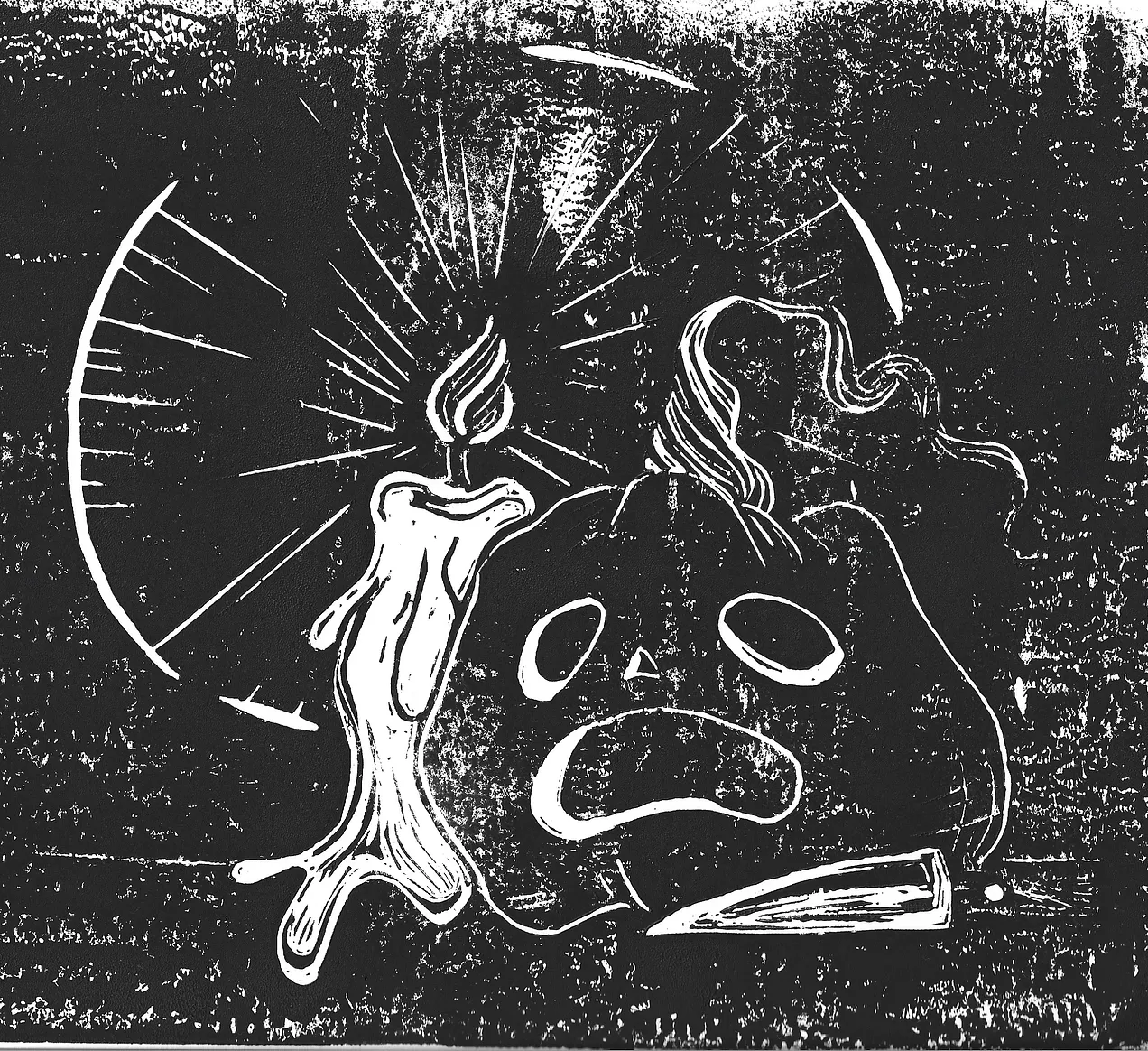
Yarb Doctor: Noun, proper. An herbalist or naturopath who uses native medicinal and edible plants, tonics, tinctures, and poultices and to treat medical aches, pains, and disease. Used to be common among the Ozark mountains due to a lack of readily available modern healthcare. The word “yarb” is merely an alternate pronunciation of the word “herb”.
— Vance Randolph, Down in the Holler
Original Art by the Lonesome Holler Artist
Mountain Canticle
This song originated in America, written as a hymn by Charles Wesley. It describes the fear of facing death and deals with facing one’s mortality. It quickly became well-loved and was sung in and out of church buildings for many generations. The following rendition is done by Doc Watson in a traditional style accompanied only by a fiddle.
Am I born to Die
And am I born to die,
To lay this body down,
And must my trembling spirit fly
Into a world unknown?
And must my trembling spirit fly
Into a world unknown?
Soon as from earth I go,
What will become of me?
Eternal happiness or woe
Must then my portion be.
Eternal happiness or woe
Must then my portion be.
A land of deepest shade,
Unpierc'd by human thought,
That dreary region of the dead
Where all things are forgot.
That dreary region of the dead
Where all things are forgot.
Ozark Howler
A bear/cat hybrid covered in black, shaggy fur. Wicked horns protrude from its head. It sports blood red eyes that give off strong reflection in the dark. The creature has been sighted many times throughout the years and is still occasionally spotted in the dark woods of the Ozarks to this day. Its name comes from a horrifying scream that can be heard on the darkest nights echoing through remote hollers.
Baked Benton Co. Apples
Before the Walmart days, Benton County Arkansas used to be known for its large apple orchards. Baked apples were a common fall treat, especially with local varieties. For an authentic baked apple use Arkansas Black apples to create a visually interesting dish from an apple variety created in Benton County. This recipe is from Mrs. Ivy’s Cookbook (~1960s)
Ingredients:
6 medium Arkansas Black Apples (or other baking apple).
7 tablespoons sugar
4 tablespoons flour
Pinch of salt
1 1/2 tablespoon butter
1 1/2 teaspoon cinnamon
Directions:
Wash and core apples. Leave skin on or pare upper half. Put into ovenware dish. Put 1 tablespoon of sugar and pinch of salt on center of each apple. Add 4 tablespoons of water. Bake at 375F for 30-45 minutes until tender. Mix remaining ingredients, pour over apples, and brown in the oven. Serve warm.
The Spooklight
October is here. The nights are getting longer and the days have traded the bright and hot summer sunshine for an amber autumn glow. The nights are cool enough to light a small fire and folks are gathering together to celebrate the harvest season. During this time of friends and family we also acknowledge that our proximity to the spiritual realm draws nearer. Ghost stories and haunted houses frequently appear during this season as we spend more time indoors contemplating the coming of cold winter and the end of the plentiful summer.
Henry, a young miner who worked for the American Zinc, Lead, and Smelting Company, was about to finish his shift working in the mines when there was a horrible accident. An explosion (to this day is still unexplained) sent a steel bar rocketing through the air. Henry was in the wrong place at the wrong time and the beam took off his helmet along with his head. His head was never recovered as it was suspected to be completely destroyed by the blast. Henry was laid to rest at his family’s home in the Oklahoma territory several miles from the accident. Ever since, folks traveling between Joplin and Henry’s resting place have sighted his kerosene lantern swinging in the air held up by Henry’s incorporeal body searching for his missing head.
Though there are many iterations, the previous tale is one frequently told still today in the western Ozarks trying to explain a strange glow found west of Joplin around the Kansas-Missouri-Oklahoma border. This strange orb of light floats just above eye level wandering around the hills and fields. Its been around as long as anyone can remember and is popularly called the ‘Spooklight’.
What is so fascinating about this particular apparition is its consistency. Ever since cars became popular in the area, folks driving through regularly report almost colliding with a motorcycle or car (sans one headlight) as they drive down the road, but after hitting the breaks or swerving they find that the light wasn’t a motor vehicle at all, rather, a phantom that quickly vanishes. Speaking to the locals in the area one hears countless tales told about personal experiences interacting with the Spooklight. The US Army Corp of Engineers and the University of Missouri have both attempted to investigate and explain this phenomena but have come up empty handed. This is not a mere tall tale that goes unverified.
What makes this tale even more intriguing is it doesn’t seem to be an isolated event. In ancient European folklore a light of this nature was assumed to be a disembodied spirit or a mischievous faerie called a will-o'-wisp. These spirits were nearly always isolated to paths, crossroads, and in-between places where travelers would be without light. As the stories go, these lights would lead lost travelers astray into nearby marshes, bogs, and wetlands pulling them further from their path in search of a distant campfire or lamp. Once they were hopelessly lost the light would vanish leaving the traveler to meet their death in the mire.
In today’s world, the changing of the seasons doesn’t impact us as directly as it did our forebears. Whether we feel it consciously or not, we still have a desire to participate in these ancient seasonal rites by telling stories that remind us of our ultimate end and realities beyond our finite comprehension.