Garbage Into Gold
Howdy
Welcome to the first issue of Lonesome Holler, a newsletter about rural life in the Ozark mountains both past and present. The following letter will follow a pattern on a monthly basis covering a wide array of topics each meant to be a quick and enjoyable read. The content herein will be sourced from local wisdom, old memories, books, and friends (with credit of course). Not being a practiced writer, the following issues of Lonesome Holler are bound to change in their format as I learn what works and what doesn’t. I want to thank each and every one of you who has shown interest in this project and hope it provides a monthly bit of entertainment worth your time.
Local Lexicon
holler: A hollow, a narrow valley, a cove. This word sometimes designates not only the hollow itself, but the stream which flows through the hollow. In some cases the stream has no other name; one does not fish Mill Creek or Mill Branch, but in Mill Holler. Sometimes this condition is reversed, so that Horse Creek means not only the stream but the whole valley as well; the settlers do not live in Horse Creek Holler, but on Horse Creek. (1927)
— Vance Randolph, Down in the Holler
Mountain Canticle
Suspected to have originated in 1700s England but soon lost to the people of the island, Pretty Saro was “rediscovered” among the folk ballads of the Ozark Mountains. The following lyrics are as sung by Jean Ritchie, but many other versions exist in various forms.
Pretty Saro, English Folk Ballad
Down in some lone valley
In a lonesome place,
Where the wild birds do whistle
And their notes do increase.
Farewell, Pretty Saro,
I bid you "adieu".
But I'll dream of Pretty Saro
Wherever I go.

My love she won't have me,
So I understand.
She wants a freeholder
Who owns house and land.
I cannot maintain her
With silver and gold.
Or buy all the fine things
That a big house can hold.

If I were a merchant
I could write a fine hand.
I would write my love a letter
that she'd understand.
I would write it by the river
Where the waters o'er flow
And I'll dream of Pretty Saro
Wherever I go.
You can listen to this song here.
Boogers, Critters, Roots, and Yarbs
Maypop
This alien-looking flower erupts from a twisting perennial vine that grows vigorously throughout the Ozarks. A differentiation between the vine and the fruit can be made, the vine being called a may-hop and the fruit maypop. This plant goes by alternate names like “wild apricot”, but most outside the Ozarks know the plant as a Passion fruit. The flower is in fullness for a mere day then soon shrivels to be replaced with a fruit. The fruit can be green to brown and has a gelatinous interior filled with black seeds. The fruit can be eaten raw or made into a jam, jelly, or incorporated into sweet desserts.
Backwoods Nourishment
Dog Gravy
Surprisingly polarizing to folks who have never heard about it before, dog gravy aka chocolate gravy is another excuse to have desert for breakfast. Generally served over fresh biscuits, this chocolate sauce is an Arkansas favorite.
Ingredients:
- 1/4 cup cocoa powder
- 3/4 cup sugar
- 2 cups milk
- 3 tablespoons flour
- 1 tablespoon butter
- 2 teaspoons vanilla extract
Directions:
Combine dry ingredients. Whisk in milk. Cook over medium heat until thickened (~5 mins). Remove from heat. Stir in butter and vanilla. Serve immediately.
Myths, Legends, and True Tales
Turtle Soup
Benton County, Arkansas has become quite the destination for both visitors and folks looking to move into the area. Its clear that the hard work of the previous generations has left the residents of Northwest Arkansas with a prosperous metro area. The residents of Benton County (and the whole of the Ozarks, for that matter) didn’t have such prosperity fall into their laps, rather it was scraped from the rocky soil. A line from a local musician shares the sentiment:
“Some people call it alchemy, some ancient art of old. Hillbillies with no money spun their garbage into gold.”
— Willi Carlisle, Folk Art Masterpiece
Spinning garbage into gold may be a miracle, but it isn’t one done easily. The tough residents of these hills drew out a living from the land, their own ingenuity, and by the grace of God almighty.
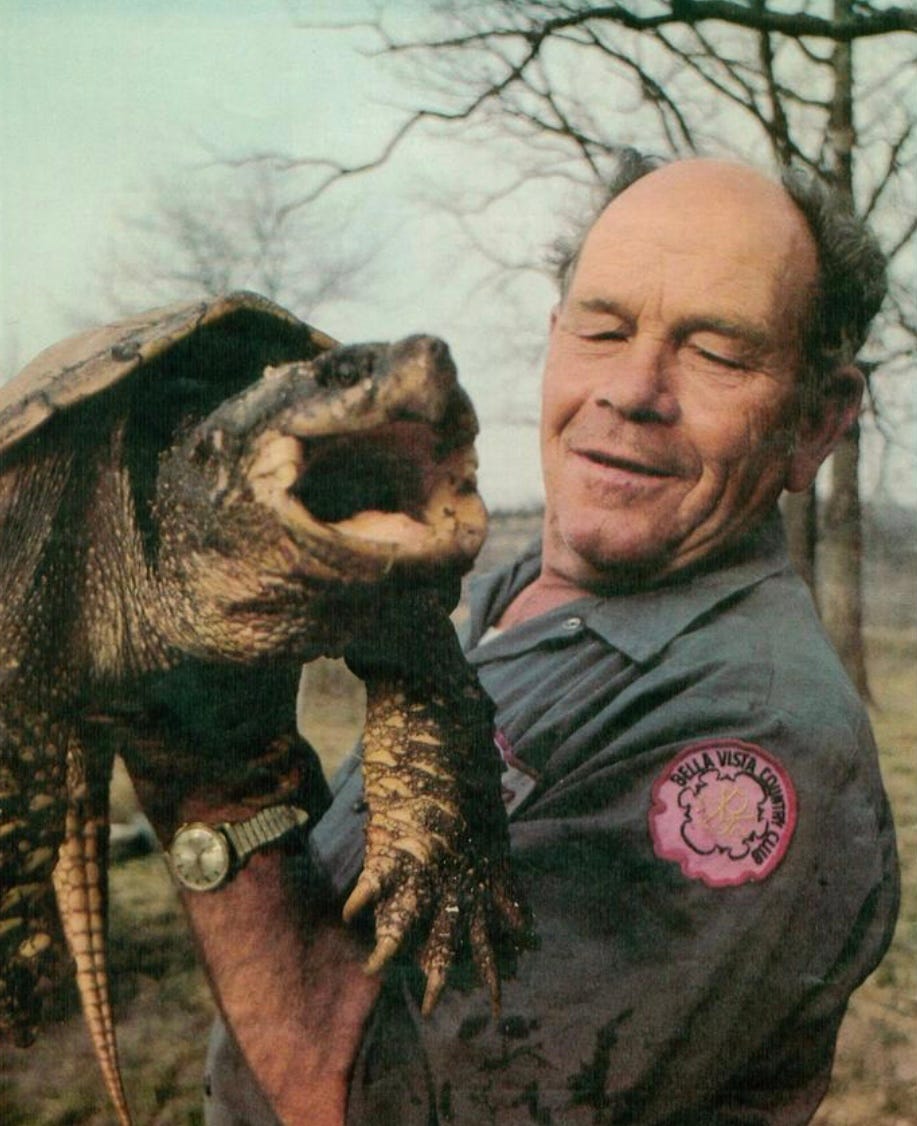
A well-loved story of this type of determination is one circulated by my wife’s family about her great-grandfather, Clifford, and great-uncle, ‘Turtle-man’ Earl:
As many residents in the Bella Vista area know the local golf courses are in a flood plain and generally have mild flooding on good years and much worse on the years with lots of rain. This space being in the watershed of the sugar creek has plenty of water with all sorts of wildlife living within. The Ozark ponds, creeks, and lakes are famous for their catfish, alligator gar, and crawdads, but one thing every ozarker knows to fear in a murky pond is the alligator snapping turtle. This dinosaur from the Miocene period can grow to be a gigantic 2 1/2 feet long and weigh 175lbs. This is not mild-mannered critter either. It exists to ruin whatever is unfortunate enough to receive its powerful bite (said to be stronger than that of a lion). To get bit by a large enough turtle could easily snap bone.
These giants are more a nuisance than they are useful for culinary purposes (although the family tells stories of the occasional turtle fry). A typical resident of Benton County (and folks in the Ozarks) generally eschews eating turtle. It could be because the only turtle with enough meat worth eating happens to be heavily armored, dangerous, angry, and ancient. In any case, you’d have to be crazy to get into a muddy pond, effectively blind, without protection, armed with nothing but a hooked stick and decide to wrangle a beast of this kind. Clifford and Earl were crazy.
The two brothers would venture out in the previously mentioned Sugar Creek watershed, wade into these ponds blind as bats poking around feeling for a hard shell. Once found, they would grab it by the tail, utilizing their stick to avoid its wicked jaws. With a firm grip, one would heave it out of the muddy hideout onto dry land. Having it out of its hiding spot, the other would encircle it, grab it by its shell, lift it aloft (all the while turtle hissing and cracking together its jaws), and carry it over to the old sedan.
If you are anything like me when I first heard this story, knowing that turtle is not often eaten in the area, you are going to ask “why”. Well, at the time, evidently the fine folks up in the Chicago area rather enjoyed eating turtle soup. Chefs in the city would pay high dollar for extremely fresh turtle to use in service of these genteel diners. I know what you’re thinking “isn’t Chicago 10 hours away”. Yes it is, and that is by modern interstate not the state highways which would’ve been the only option at the time.
So - the brothers, with turtle in tow, would pop the trunk (which they called the “turtle hull”) and toss in the turtle (still kickin’), hop into the front seats and burn rubber headed northeast to hawk their prize to some sucker who would pay top dollar for their angry catch. Evidently selling these turtles paid a large enough sum to make the 20+ hour round trip worth their while. If that isn’t a hard-earned paycheck, I don’t know what is.